Showing posts with label Astronomy Picture of the Day. Show all posts

Monday, 29 October 2007

Noctilucent Clouds


reposted from: http://antwrp.gsfc.nasa.gov/apod/astropix.html

Noctilucent Clouds Over Sweden
Credit & Copyright: P-M Hedén

Explanation: Sometimes it's night on the ground but day in the air. As the Earth rotates to eclipse the Sun, sunset rises up from the ground. Therefore, at sunset on the ground, sunlight still shines on clouds above. Under usual circumstances, a pretty sunset might be visible, but unusual noctilucent clouds float so high up they can be seen well after dark. Pictured above last month, a network of noctilucent clouds cast a colorful but eerie glow after dusk near Vallentuna, Sweden. Although noctilucent clouds are thought to be composed of small ice-coated particles, much remains unknown about them. Satellites launched to help study these clouds includes Sweden's Odin and NASA's AIM. Recent evidence indicates that at least some noctilucent clouds result from freezing water exhaust from Space Shuttles.

Read More...

Saturday, 27 October 2007

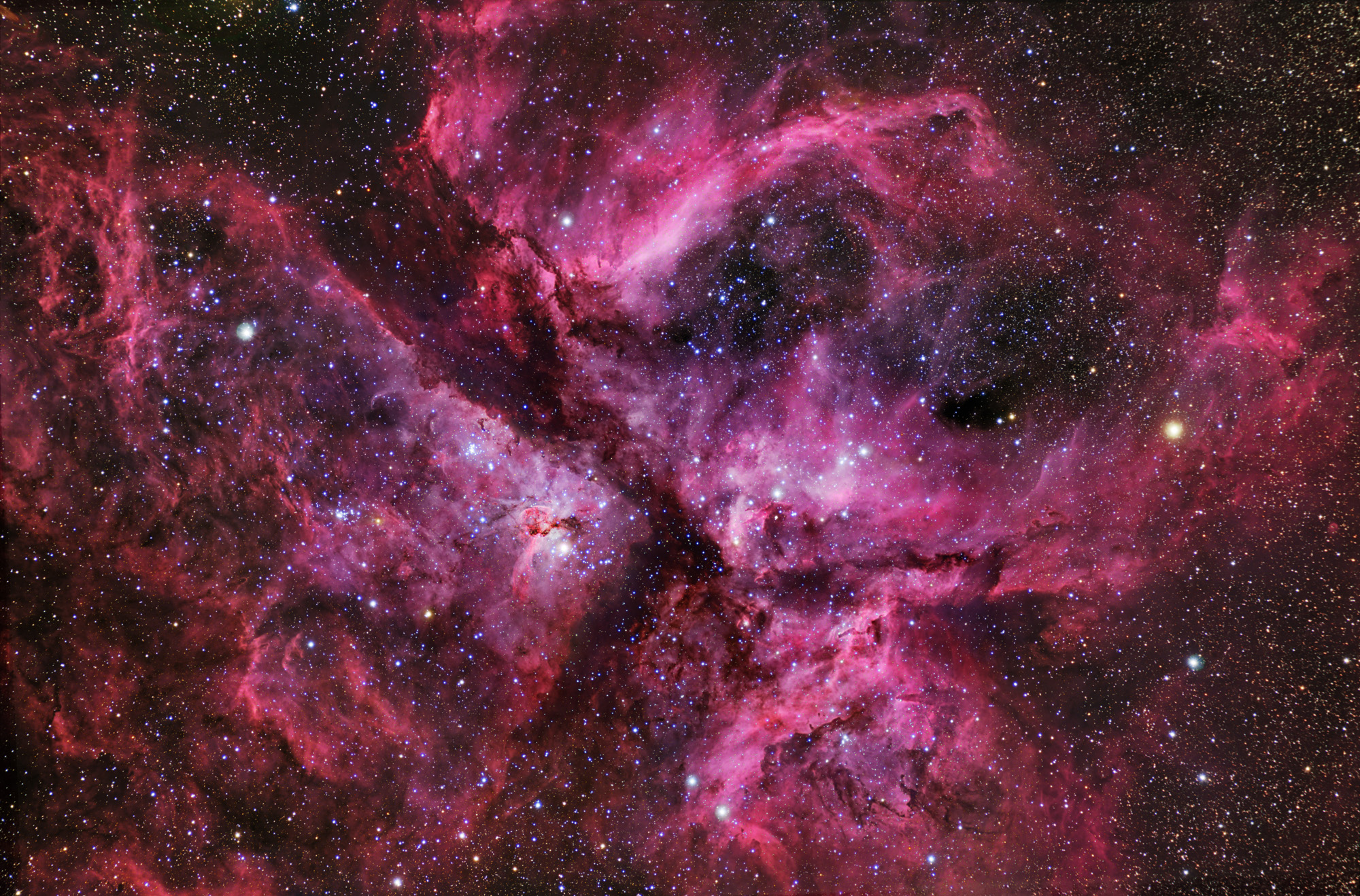
The Great Carina Nebula


reposted from: http://antwrp.gsfc.nasa.gov/apod/astropix.html
WASP comments are in bright green; highlights in blockquotes (yellow).

The Great Carina Nebula
Credit & Copyright: Robert Gendler and Stephane Guisard

Explanation: A jewel of the southern sky, the Great Carina Nebula, aka NGC 3372, spans over 300 light-years, one of our galaxy's largest star forming regions. Like the smaller, more northerly Orion Nebula, the Carina Nebula is easily visible to the naked eye, though at a distance of 7,500 light-years it is some 5 times farther away. This stunning telescopic view reveals remarkable details of the region's glowing filaments of interstellar gas and dark cosmic dust clouds. The Carina Nebula is home to young, extremely massive stars, including the still enigmatic variable Eta Carinae, a star with well over 100 times the mass of the Sun. Eta Carinae is the bright star left of the central dark notch in this field and just below the dusty Keyhole Nebula (NGC 3324).

Read More...

Tuesday, 9 October 2007

Aurora, Stars, Meteor, Lake, Alaska


reposted from: http://antwrp.gsfc.nasa.gov/apod/astropix.html

Astronomy Picture of the Day

Discover the cosmos! Each day a different image or photograph of our fascinating universe is featured, along with a brief explanation written by a professional astronomer.

2007 October 9

Aurora, Stars, Meteor, Lake, Alaska
Credit & Copyright: Bud Kuenzli

Explanation: Sometimes, after your eyes adapt to the dark, a spectacular sky appears. In this case, a picturesque lake lies in front of you, beautiful green aurora flap high above you, brilliant stars shine far in the distance, and, for a brief moment, a bright meteor streaks by. This digitally fused breathtaking panorama was captured late last month across one of the Chena Lakes in North Pole, Alaska, USA, and includes the Pleiades open cluster of stars on the image right. The shot is unusual not only for the many wonders it has captured simultaneously, but because lakes this far north tend to freeze and become non-reflecting before a sky this dark can be photographed.

Read More...

Sunday, 7 October 2007

Two Million Galaxies


reposted from: http://antwrp.gsfc.nasa.gov/apod/astropix.html

Two Million Galaxies
Credit & Copyright: S. Maddox (Nottingham U.) et al. APM Survey, Astrophys. Dept. Oxford U.

Explanation: Our universe is filled with galaxies. Galaxies -- huge conglomerations of stars, gas, dust -- and mysterious dark matter are the basic building blocks of the large-scale universe. Although distant galaxies move away from each other as the universe expands, gravity attracts neighboring galaxies to each other, forming galaxy groups, clusters of galaxies, and even larger expansive filaments. Some of these structures are visible on one of the most comprehensive maps of the sky ever made in galaxies: the APM galaxy survey map completed in the early 1990s. Over 2 million galaxies are depicted above in a region 100 degrees across centered toward our Milky Way Galaxy's south pole. Bright regions indicate more galaxies, while bluer colors denote larger average galaxies. Dark ellipses have been cut away where bright local stars dominate the sky. Many scientific discoveries resulted from analyses of the map data, including that the universe was surprisingly complex on large scales.

Read More...

Sunday, 30 September 2007

Astronomy Picture of the Day - Milky Way


reposted from:

Astronomy Picture of the Day

Discover the cosmos! Each day a different image or photograph of our fascinating universe is featured, along with a brief explanation written by a professional astronomer.

2007 September 30
A Milky Way Band
Credit & Copyright: John P. Gleason, Celestial Images

Explanation: Most bright stars in our Milky Way Galaxy reside in a disk. Since our Sun also resides in this disk, these stars appear to us as a diffuse band that circles the sky. The above panorama of a northern band of the Milky Way's disk covers 90 degrees and is a digitally created mosaic of several independent exposures. Scrolling right will display the rest of this spectacular picture. Visible are many bright stars, dark dust lanes, red emission nebulae, blue reflection nebulae, and clusters of stars. In addition to all this matter that we can see, astronomers suspect there exists even more dark matter that we cannot see.

Read More...