Showing posts with label Universe origin. Show all posts

Wednesday, 16 May 2007

Galaxies 400-800 Million years after Big Bang (3-6% life of Universe)


The Universe is 13.7 Billion years old. So 400-800 Million years is 3-6% of the life of the Universe or on a 24 hour scale about 1am -2am.

Astronomers at the Space Telescope Science Institute today have the deepest portrait of the visible universe ever achieved by humankind. Called the Hubble Ultra Deep Field (HUDF), the million-second-long exposure reveals the first galaxies to emerge from the so-called "dark ages," the time shortly after the big bang when the first stars reheated the cold, dark universe.

Source:

19. Comment #27123 by Rtambree on March 23, 2007 at 8:07 am

Another debating point could be scored by showing the audience a picture of Hubble Ultra Deep Field - it's the furtherest we've seen in the Universe.
http://hubblesite.org/newscenter/archive/releases/2004/07/image/a/

Once you explain to your audience what it is they're looking at (galaxies not stars), then ask your theist opponent how he can still hold seriously the notion of a personal God.

I've used it a few times with believes and because it's an ACTUAL PHOTO (not just logical arguments), it works well in instilling doubt.

Read More...

Monday, 7 May 2007

Is the Universe Fine Tuned? by Steven Weinberg

Now, it doesn't settle the matter for me to say that we cannot see the hand of a designer in what we know about the fundamental principles of science. It might be that, although these principles do not refer explicitly to life, much less human life, they are nevertheless craftily designed to bring it about.

Some physicists have argued that certain constants of nature have values that seem to have been mysteriously fine-tuned to just the values that allow for the possibility of life, in a way that could only be explained by the intervention of a designer with some special concern for life. I am not impressed with these supposed instances of fine-tuning. For instance, one of the most frequently quoted examples of fine-tuning has to do with the energy of a certain excited state of the carbon nucleus. The build-up in stars of elements necessary for life, like carbon and oxygen, depends on the carbon nucleus having an excited state at an energy within a narrow range, where in fact just such a state is found. The reason that it has to have this energy is to provide a way for carbon nuclei be formed in stars in collisions of helium nuclei with unstable beryllium nuclei, which is a necessary step in the build-up of all elements heavier than helium. But recent calculations show that, as has been long expected, without any fine tuning of the constants of nature one would in any case expect the carbon nucleus to have a state like an unstable molecule, consisting of a helium nucleus and a beryllium nucleus, which would naturally have an energy close to the values necessary for the synthesis of carbon and heavier elements.This excited state of the carbon nucleus is 7.65 million electron volts (MeV) above the energy of the carbon nucleus in its normal state, the state of lowest energy. Calculations [M. Livio, D. Hollowell,...

There is one constant whose value does seem remarkably well adjusted in our favor. It is the energy density of empty space, also known as the cosmological constant. It could have any value, but from first principles one would guess that this constant should be very large - much too large to allow matter to clump together in the early universe, which is the first step in forming galaxies and stars and planets and people. It's too early to tell if this is a real problem, or if there is some fundamental principle that explains why the cosmological constant must be this small.

But even if there is no such principle, recent developments in cosmology offer the possibility of an explanation why the measured values of the cosmological constant and other physical constants are favorable for the appearance of intelligent life. Sidney Coleman has shown how quantum mechanical effects can lead to a picture of the wave function of the universe in which the wave function is the sum of many different terms, each term corresponding to a big (or little) bang in which what we call the constants of nature take all possible values. Also, as you have heard here from Alan Guth, in the `chaotic inflation' theories of Andre Linde and others our big bang is supposed to be just one episode in a much larger universe in which big bangs go off all the time, each with different values of the fundamental constants.

In any such picture, in which the universe contains many parts with different values for what we call the constants of nature, there would be no difficulty in understanding why these constants take values favorable to intelligent life. There would be a vast number of big bangs in which the constants of nature take values unfavorable for life, and much fewer where life is possible. You don't have to invoke a benevolent designer to explain why we are in one of the parts of the universe where life is possible. In all the other parts of the universe there is no one to raise the question.

To conclude that the constants of nature have been fine-tuned by a benevolent designer is like saying “Isn't it wonderful that God put us here on earth, where there's water and air and the surface gravity and temperature are so comfortable, rather than some horrid place, like Mercury or Pluto.” Where else in the solar system but on earth could we have evolved?

Reasoning like this is called “anthropic.” Sometimes it just amounts to an assertion that the laws of nature are what they are so that we can exist, without further explanation. This seems to me to be little more than mystical mumbo-jumbo. On the other hand, if there really is a large number of worlds in which some constant takes different values, then the anthropic explanation of why in our world it takes values favorable for life is just common sense, like explaining why we live on the earth rather than Mercury or Pluto. The actual value of the cosmological constant, recently measured by observations of the motion of distant supernovas, is about what you would expect from this sort of argument; it is just about small enough to prevent it from interfering with the formation of galaxies and so on. But we don't yet know enough about physics to tell whether there are different parts of the universe in which what are usually called the constants of physics really do take different values. This is not a hopeless question; we will be able to answer it when we know more about the quantum theory of gravitation than we do now.

Read More...

Saturday, 28 April 2007

The cosmos - before the big bang

The Universe before ours

How did the universe begin? The question is as old as humanity. Sure, we know that something like the big bang happened, but the theory doesn't explain some of the most important bits: why it happened, what the conditions were at the time, and other imponderables.

Many cosmologists think our standard picture of how the universe came to be is woefully incomplete or even plain wrong, and they have been dreaming up a host of strange alternatives to explain how we got here. For the first time, they are trying to pin down the initial conditions of the big bang. In particular, they want to solve the long-standing mystery of how the universe could have begun in such a well-ordered state, as fundamental physics implies, when it seems utter chaos should have reigned.

Several models have emerged that propose intriguing answers to this question. One says the universe began as a dense sea of black holes. Another says the big bang was sparked by a collision between two membranes floating in higher-dimensional space. Yet another says our universe was originally ripped from a larger entity, and that in turn countless baby universes will be born from the wreckage of ours. Crucially, each scenario makes unique and testable predictions; observations coming online in the next few years should help us to decide which, if any, is correct.

Not that modelling the origin of the universe is anything new. The conventional approach is to take the laws of physics and extrapolate backwards from the present. From observations dating back to the 1920s, we can see that galaxies are moving farther and farther apart: the universe is expanding. By reversing that expansion, researchers concluded that 13.7 billion years ago the universe was in a very small, dense and hot state. The big bang theory, first proposed in 1927 by Georges LemaƮtre, was bolstered in 1964 by the discovery of the cosmic microwave background - the radiation filling the universe that is thought to be a relic of the big bang - and has ruled ever since.

In 1981, a major addition was made to the big bang picture. Alan Guth of the Massachusetts Institute of Technology and others proposed that the expansion of the early universe happened much faster than originally thought. This theory, called cosmic inflation, explained the surprising uniformity of the visible universe by saying that it grew exponentially from a patch that was extremely tiny to start with (New Scientist, 3 March, p 33). Though highly successful in this regard, inflation still doesn't explain the initial conditions of the universe.

Brick wall

That's because inflation would have taken place between 10-35 and 10-32 seconds after the big bang. Going back further in time, we hit a brick wall because the two pillars of modern physics - quantum field theory and general relativity - break down. Physicists don't have a complete recipe with which to concoct the behaviour of matter, energy and space-time under such extreme conditions, and it's hard to blame them.

To get around this, some are basing their ideas around an age-old tenet. The second law of thermodynamics dictates that the entropy of the universe - a measure of its disorder - increases with time. So the universe began in its most orderly state and has been getting messier ever since. The problem is, it would have been more likely to be chaotic and disordered, so what was this initial state? "It's tremendously important that any respectable model of the early universe explains why entropy is so low near the big bang," says Sean Carroll, a cosmologist at the California Institute of Technology in Pasadena.

Enter the first of the new models. The entropy question has led Thomas Banks of the University of California, Santa Cruz, and Willy Fischler of the University of Texas at Austin to conclude that the universe in its earliest moments - when it was less than 10-35 seconds old - was a sea of black holes. They call this scenario "holographic cosmology".

The idea is based on the holographic principle, which was proposed in 1993 by Gerard't Hooft of Utrecht University in the Netherlands and developed by Leonard Susskind of Stanford University in California. Although it is unproven, many physicists think the holographic principle is right: all the information in a given volume of space can be represented by physical laws that exist on its surface. Entropy can be thought of as a measure of information content - the more disordered a system, the more information it takes to describe it. Cast in these terms, the holographic principle says the entropy in a given volume is limited by its surface area, and maximised in the case of a black hole.

Now imagine turning back the clock towards the big bang. Matter and energy get packed together more densely into each shrinking region of space until we reach the entropy density limit, which corresponds to filling up these regions with a sea of microscopic black holes.

According to Banks and Fischler, the universe began as this black hole "fluid" (see Diagram). From any vantage point, black holes would fill the entire space around, but how densely they fill it would fluctuate according to the uncertainty principle of quantum mechanics. A fluctuation towards lower density would mean that in that region the black hole event horizons would not fill every last bit of volume, but would have some ordinary space between them, free of black holes and filled with radiation.

This creates the conditions for our observable universe to come into existence. If the black holes in the region where ordinary space opens up are densely packed and moving fast, their collisions and mergers make them grow until they fill the space, pulling it back into the black hole fluid. But if the black holes are far enough apart and moving slowly, mergers won't happen fast enough. In such a region the ordinary space filled with hot radiation would quickly expand, pushing the black holes further apart.

About 10-35 seconds after the beginning of time, this bubble of ordinary space joins up with the conventional picture, in which inflation expands our universe to more than 1 kilometre across in a tiny fraction of a millisecond. Eventually, particles condense out of the radiation to produce the building blocks of stars, galaxies, planets and life.

So how do Banks and Fischler explain the low entropy of the early universe? Many bubbles of ordinary space could have emerged from the black hole fluid, but to avoid collapsing back into the fluid, they need to have low entropy (www.arxiv.org/hep-th/0701146). That's because higher entropy corresponds to faster-moving black holes that are prone to colliding and merging. If our bubble of space had begun with higher entropy, it would not have survived. "There wouldn't have been a universe to live in," Banks says.

Other researchers are still debating the merits of holographic cosmology. "It's a very interesting speculation that is neither obviously true nor obviously false. Time will tell," says Susskind. After all, he says, "there is an enormous gulf separating the earliest origin from observational cosmology".

The model raises the controversial issue of whether time began at the big bang. "There's no necessity in the rules of quantum mechanics for time to extend out to the infinite past, or for that matter, the infinite future," Banks says. An origin of time has its own problems, though. "If there were no beginning, I would sleep better at night. I think it would be more elegant," says Max Tegmark, a cosmologist at MIT. A beginning of time raises the question of "why certain things come into existence and others don't".

In other words, this approach does not explain the origin of the big bang, says Paul Steinhardt of Princeton University. In 2002 he and Neil Turok of the University of Cambridge proposed a scenario in which the big bang is not the beginning of time, but just the start of another cosmological cycle (New Scientist, 16 March 2002, p 26). Their model, which has withstood some recent challenges, provides a different mechanism for the low entropy of the early universe.
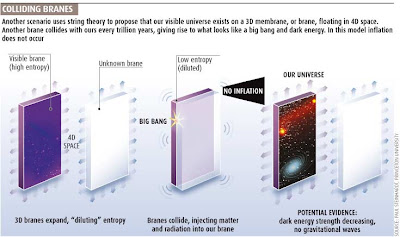
Steinhardt and Turok's model is motivated by string theory, an approach to unifying relativity and quantum mechanics in which there are extra dimensions of space beyond the three we can see. In their model, our visible universe is a 3D sheet called a membrane, or brane, floating in four-dimensional space (see Diagram). Another 3D brane, with possibly very different physics, hovers nearby. The branes collide every so often, making ours heat up to an astronomical 1023 kelvin and expand, with some energy eventually condensing into matter. From our point of view, confined to our brane, it would look like a big bang - even though the universe was already there.

After the branes collide they separate and stretch out, causing the expansion of space within them to speed up. This corresponds to the accelerated expansion of the universe that researchers observe today and explain by invoking a repulsive force known as dark energy (New Scientist, 17 February, p 28). The branes will eventually slow down, stop and start hurtling towards one another again. Whenever the next collision occurs, new matter and radiation will be injected into our brane, as if a new big bang has gone off.

One potential problem with this "cyclic brane" model is that small differences in the distribution of matter and energy within our brane could get amplified during a collision, leading to a lumpy universe that looks nothing like ours. Steinhardt and Turok have argued, however, that dark energy becomes stronger as the branes approach one another, and that this overwhelms the small fluctuations, keeping the universe smooth.

The cyclic brane model might seem radically different from Banks and Fischler's black hole fluid scenario - what's more, it does not invoke conventional inflation - but remarkably they share some common ground. Black holes would be produced in copious amounts under the extreme conditions of a brane collision, Steinhardt says. "Maybe it's not so different from the state that Banks and Fischler have in mind," he says.

Stretch your brane

Yet its explanation of the low-entropy question is quite different. The second law of thermodynamics makes it hard for a given cosmological cycle to start with low entropy: you'd think entropy would have accumulated in previous cycles. The brane scenario solves this problem. The stretching of each brane means that matter, radiation and entropy all get enormously diluted before a collision. By the time of the "big bang" that follows, the entropy density - and therefore the total entropy that any observer can see - is very low. To get enough dilution, the universe must go at least a trillion years between collisions.

Though intriguing, the model has yet to gain widespread support. "It's quite specific, and it does try to be an alternative to inflation, which is absolutely a good thing to have," says Carroll, but he is still unconvinced. "It's not very clear to many people why this would be considered an improvement [on inflation]."

As for the beginning of time, there is no way to tell whether the cycling has been going on forever. "We don't know yet how to make that into a scientifically decidable question," Steinhardt says. The problem is that information about previous cycles tends to get scrambled. Even if the cycling had a beginning, there may be no way to detect it. Nevertheless Steinhardt remains optimistic. "We addressed a lot of the show-stopper problems that might have stopped people from thinking about cyclic models," he says. "That's really opened the door for people to come up with other imaginative ideas that take us back to the big bang and beyond."

One such model that has emerged says our universe began as a fragment of a mother universe shattered by dark energy, and that our universe will in turn give rise to countless others. Developed by Lauris Baum and Paul Frampton, both from the University of North Carolina in Chapel Hill, the scenario also manages to get around the problem of accumulating entropy, but in a different way (Physical Review Letters, vol 98, 071301).

Did we emerge from a black hole sea, bouncing brane or mother universe?

Their model starts with the assumption that the amount of dark energy in a given volume increases as the universe expands. This is plausible, as measurements to date of dark energy are imprecise. A slowly increasing density would lead the repulsive force to destroy galaxies, stars and even individual atoms, culminating in an irreversible disaster called the "big rip" in which the universe's expansion rate becomes infinite. So Baum and Frampton designed the model's dark energy to have an attractive force as well that starts out negligible but later grows quickly; the repulsive aspect dominates when the universe is young and small, which is still the case now.

According to their scenario, the universe is expanding faster and faster, diluting matter and radiation enormously. Eventually, each patch of the universe moves away from other regions faster than the speed of light. This does not violate the speed limit dictated by relativity, since the expansion of space itself is happening faster than light, rather than the motion of particles through that space. Since no particle or force can travel faster than light, each patch is cut off from the others and becomes an island universe.

Left just a bit longer, this process would lead to the end of the universe, but at the last instant, less than 10-27 seconds before a would-be big rip, the attractive aspect of the dark energy finally overtakes the repulsive part. This causes each island universe to contract, but eventually it gets so dense that its radiation reverses the contraction. We are left with innumerable expanding little universes - of which ours may have been one (see Diagram). At this point, the model joins up with the standard inflation scenario, and matter eventually clumps together to form the stars and galaxies we see around us.

What about the low-entropy question? As in the cyclic brane model, the fragmenting universe manages to avoid being hobbled by the accumulation of entropy from cycle to cycle. At the end of each cycle, the entropy that has been produced is divided among the huge number of new universes spawned from the fragmentation of the old one. As a result, the baby universes each begin with a clean slate.

Far in the future, the whole process will repeat itself, spawning countless new universes from the wreckage of ours. This suggests that the number of universes was smaller in the past. If we go back far enough, was there an original universe that started it all? In other words, would time still have a beginning? No, says Frampton. "I would say the number of universes is and always has been and always will be infinite," he says.

Others find the scenario fascinating but incomplete. "It's a kind of new idea," says Steinhardt. The model pushes entropy outside the borders of our early universe, he says. "But how do you get this turnaround? That remains to be explained." Some are more dubious of cyclic models in general. "I have not seen any theory that's convinced me that it really works forever into the past," says Tegmark.

Dark predictions

Any kind of conviction will require new experimental evidence. Fortunately, the two cyclic models make very different predictions that should allow researchers to choose between them. Dark energy appears in both, but its behaviour is different. In order for the fragmenting universe scenario to work, the dark energy first has to grow stronger - more and more dense - as the universe expands. Physicists denote different behaviours of dark energy using a parameter they call w, which describes how dark energy varies with time.

Dark energy that stays the same as the universe expands corresponds to a w of -1, and is sometimes called a cosmological constant. Dark energy that increases with time, as in the fragmenting universe, corresponds to a w with a more negative value, for example, -1.05. By contrast, in the cyclic brane model, dark energy results from the potential energy between the two branes, which depends on how far apart they are. As the branes move apart, as they would be now, dark energy's strength decreases. This corresponds to a w that is greater than -1, for example, -0.95.

Since dark energy affects the universe's expansion, researchers can look for changes in its strength by measuring the rate of expansion at different times in the universe's history. Astronomers do this by using supernova explosions; these allow them to measure the speed of receding galaxies at different points in time. Of course, this method can only tell us about dark energy after stars formed, but the cosmic microwave background can be used to chart its strength back to a much earlier time, 380,000 years after the big bang, when the universe first became transparent to light. Looking nearly 13.7 billion light-years away in any direction, we see the radiation emitted by the hot gas that filled the early universe. From this background radiation, astronomers can measure the recession speed of the gas, which tells us how fast the universe was expanding at the time.

Combining the two methods suggests that dark energy is constant or nearly constant, with w close to -1. That is where new measurements come in. The European Space Agency (ESA) Planck satellite, scheduled to launch in 2008, will measure the microwave background with the greatest precision to date, allowing w to be calculated to within about 1 per cent. If Planck shows w to be definitively on one side or the other of -1, then one of the two cyclic models would be ruled out. If it is very nearly -1, both would suffer. "Let's hope it's not too close," says Frampton.

Testing holographic cosmology and its sea of black holes is likely to be more difficult. One piece of evidence is potentially observable: black holes from the early universe, some of which should have survived to the present day. "That would be something to look for," Banks says.

Primordial black holes are also produced in the cyclic brane scenario, but they would be tiny and would be expected to evaporate a fraction of a second after their birth through a process called Hawking radiation.

The largest black holes from holographic cosmology, though less than 100 grams, might survive to the present day because of a strange property: they would possess a magnetic field with just one pole. All magnets observed to date come in north-south pairs, but physicists believe that "monopoles" - magnetic particles with only one pole - would have been produced in the early universe. The relic black holes would have sucked in large numbers of monopoles, which, crucially, could be as big as 1016 times the mass of a proton. Particles that large tend to resist being ejected as radiation, so some black holes would retain their contents and might still exist nearby, perhaps at the centre of our galaxy where the gravitational field is strong. Their small size, however, suggests they would be hard to spot; Banks and Fischler have not yet worked out whether it is likely that they can be found.

There may be another way to distinguish between the models. In the standard big bang picture, gravitational waves are generated during inflation from collisions of clumps of matter. Some of these waves might be observed, either by future gravitational wave detectors such as the ESA and NASA-sponsored Laser Interferometer Space Antenna, planned to launch in 2015, or by the imprint they would leave on the cosmic microwave background. In the colliding-brane model, however, inflation never happens, which means primordial gravitational waves would not be produced. Observing them would rule out that model, while leaving viable the black hole fluid and fragmenting universe scenarios.

The most likely outcome, however, is that none of the models will be proved correct any time soon. Indeed, the quest to understand the origin of the universe seems destined to continue until we can answer a deeper question: why is there anything at all instead of nothing?

From issue 2601 of New Scientist magazine, 28 April 2007, page 28-33

Spikes in space-time

There is another way to think about why our universe began in a highly ordered or "low entropy" state. In 2002, a group of physicists led by Leonard Susskind at Stanford University in California proposed that entities capable of observing the universe could arise via random thermal fluctuations, as opposed to the big bang, galaxy formation and evolution. This idea has been explored by others, including Don Page at the University of Alberta in Edmonton, Canada. Some researchers argue that under certain conditions, self-aware entities in the form of disembodied spikes in space-time - "Boltzmann brains" - are more likely to emerge than complex life forms. Because they depend on fluctuations of particles, Boltzmann brains would be more common in regions of high entropy than low entropy. If the universe had started out in a state of high entropy, it would be more likely to be populated by Boltzmann brains than life forms like us, which suggests that the entropy of our early universe had to be low. As a low-entropy initial state is unlikely, though, this also implies that there are a huge number of other universes out there that are unsuitable for us.

reposted from: new scientist

  • 28 April 2007
  • by David Shiga
  • Magazine issue 2601


my: highlights / emphasis / key points / comments

Read More...

Tuesday, 24 April 2007

Stephen Hawking Says Universe Created from Nothing


by Slashdot Thanks to James Pycroft for the link.

Reposted from:

http://science.slashdot.org/science/07/03/14/172226.shtml

"Speaking to a sold out crowd at the Berkeley Physics Oppenheimer Lecture, Hawking said yesterday that he now believes the universe spontaneously popped into existence from nothing. He said more work is needed to prove this but we have time because 'Eternity is a very long time, especially towards the end.' There is also a Webcast available (Realplayer or Real Alternative required)."


hawkingTRANSCRIPT: Origins of the universe: Stephen Hawking's J. Robert Oppenheimer Lecture

BERKELEYThe is the text of the J. Robert Oppenheimer Lecture in Physics, delivered March 13, 2007, by Stephen Hawking, the Lucasian professor of mathematics at Cambridge University. Hawking spoke at Zellerbach Hall on the campus of the University of California, Berkeley.

Can you hear me?

According to the Boshongo people of central Africa, in the beginning there was only darkness, water, and the great god Bumba. One day Bumba, in pain from a stomach ache, vomited up the sun. The sun dried up some of the water, leaving land. Still in pain, Bumba vomited up the moon, the stars, and then some animals. The leopard, the crocodile, the turtle, and, finally man.

This creation myth, like many others, tries to answer the questions we all ask. Why are we here? Where did we come from? The answer generally given, was that humans were of comparatively recent origin, because it must have been obvious, even at early times, that the human race was improving in knowledge and technology. So it can't have been around that long, or it would have progressed even more. For example, according to Bishop Usher, the Book of Genesis placed the creation of the world at 9 in the morning, on October the 27th, 4,004 BC. On the other hand, the physical surroundings, like mountains and rivers, change very little in a human life time. They were therefore thought to be a constant background, and either to have existed for ever as an empty landscape, or to have been created at the same time as the humans.

Not everyone however, was happy with the idea that the universe had a beginning. For example, Aristotle, the most famous of the Greek philosophers, believed the universe had existed for ever. Something eternal, is more perfect than something created. He suggested the reason we see progress, was that floods, or other natural disasters, had repeatedly set civilization back to the beginning. The motivation for believing in an eternal universe, was the desire to avoid invoking divine intervention, to create the universe, and set it going. Conversely, those who believed the universe had a beginning, used it as an argument for the existence of God, as the first cause, or prime mover of the universe.

If one believed that the universe had a beginning, the obvious question was, What happened before the beginning? What was God doing before He made the world? Was He preparing Hell for people who asked such questions? The problem of whether or not the universe had a beginning, was a great concern to the German philosopher, Immanuel Kant. He felt there were logical contradictions, or Antimonies, either way. If the universe had a beginning, why did it wait an infinite time before it began? He called that the thesis. On the other hand, if the universe had existed for ever, why did it take an infinite time to reach the present stage? He called that the anti thesis. Both the thesis, and the anti thesis, depended on Kant's assumption, along with almost everyone else, that time was Absolute. That is to say, it went from the infinite past, to the infinite future, independently of any universe that might or might not exist in this background.

This is still the picture in the mind of many scientists today. However in 1915, Einstein introduced his revolutionary General Theory of Relativity. In this, space and time were no longer Absolute, no longer a fixed background to events. Instead, they were dynamical quantities that were shaped by the matter and energy in the universe. They were defined only within the universe, so it made no sense to talk of a time before the universe began. It would be like asking for a point south of the South Pole. It is not defined.

If the universe was essentially unchanging in time, as was generally assumed before the 1920s, there would be no reason that time should not be defined arbitrarily far back. Any so-called beginning of the universe, would be artificial, in the sense that one could extend the history back to earlier times. Thus it might be that the universe was created last year, but with all the memories and physical evidence, to look like it was much older. This raises deep philosophical questions about the meaning of existence. I shall deal with these by adopting what is called, the positivist approach. In this, the idea is that we interpret the input from our senses in terms of a model we make of the world. One can not ask whether the model represents reality, only whether it works. A model is a good model, if first it interprets a wide range of observations, in terms of a simple and elegant model. And second, if the model makes definite predictions that can be tested, and possibly falsified, by observation.

In terms of the positivist approach, one can compare two models of the universe. One in which the universe was created last year, and one in which the universe existed much longer. The model in which the universe existed for longer than a year, can explain things like identical twins, that have a common cause more than a year ago. On the other hand, the model in which the universe was created last year, can not explain such events. So the first model is better. One can not ask whether the universe really existed before a year ago, or just appeared to. In the positivist approach, they are the same.

In an unchanging universe, there would be no natural starting point. The situation changed radically however, when Edwin Hubble began to make observations with the hundred inch telescope on Mount Wilson, in the 1920s.

Hubble found that stars are not uniformly distributed throughout space, but are gathered together in vast collections called galaxies.

By measuring the light from galaxies, Hubble could determine their velocities. He was expecting that as many galaxies would be moving towards us, as were moving away. This is what one would have in a universe that was unchanging with time. But to his surprise, Hubble found that nearly all the galaxies were moving away from us. Moreover, the further galaxies were from us, the faster they were moving away. The universe was not unchanging with time, as everyone had thought previously. It was expanding. The distance between distant galaxies, was increasing with time.

The expansion of the universe, was one of the most important intellectual discoveries of the 20th century, or of any century. It transformed the debate about whether the universe had a beginning. If galaxies are moving apart now, they must have been closer together in the past. If their speed had been constant, they would all have been on top of one another, about 15 billion years ago. Was this, the beginning of the universe.

Many scientists were still unhappy with the universe having a beginning, because it seemed to imply that physics broke down. One would have to invoke an outside agency, which for convenience, one can call God, to determine how the universe began. They therefore advanced theories in which the universe was expanding at the present time, but didn't have a beginning. One was the Steady State theory, proposed by Bondi, Gold, and Hoyle in 1948.

In the Steady State theory, as galaxies moved apart, the idea was that new galaxies would form from matter that was supposed to be continually being created throughout space. The universe would have existed for ever, and would have looked the same at all times. This last property had the great virtue, from a positivist point of view, of being a definite prediction, that could be tested by observation. The Cambridge radio astronomy group, under Martin Ryle, did a survey of weak radio sources in the early 1960s. These were distributed fairly uniformly across the sky, indicating that most of the sources, lay outside our galaxy. The weaker sources would be further away, on average.

The Steady State theory predicted the shape of the graph of the number of sources, against source Strength. But the observations showed more faint sources than predicted, indicating that the density sources was higher in the past. This was contrary to the basic assumption of the Steady State theory, that everything was constant in time. For this, and other reasons, the Steady State theory was abandoned.

Another attempt to avoid the universe having a beginning, was the suggestion that there was a previous contracting phase, but because of rotation and local irregularities, the matter would not all fall to the same point. Instead, different parts of the matter would miss each other, and the universe would expand again, with the density remaining finite. Two Russians, Lifshitz and Khalatnikov, actually claimed to have proved that a general contraction without exact symmetry, would always lead to a bounce, with the density remaining finite. This result was very convenient for Marxist Leninist dialectical materialism, because it avoided awkward questions about the creation of the universe. It therefore became an article of faith for Soviet scientists.

When Lifshitz and Khalatnikov published their claim, I was a 21–year-old research student, looking for something to complete my PhD thesis. I didn't believe their so-called proof, and set out with Roger Penrose to develop new mathematical techniques to study the question. We showed that the universe couldn't bounce. If Einstein's General Theory of Relativity is correct, there will be a singularity, a point of infinite density and space-time curvature, where time has a beginning.

Observational evidence to confirm the idea that the universe had a very dense beginning, came in October 1965, a few months after my first singularity result, with the discovery of a faint background of microwaves throughout space. These microwaves are the same as those in your microwave oven, but very much less powerful. They would heat your pizza only to minus 271 point 3 degrees centigrade, not much good for defrosting the pizza, let alone cooking it. You can actually observe these microwaves yourself. Set your television to an empty channel. A few percent of the snow you see on the screen, will be caused by this background of microwaves. The only reasonable interpretation of the background, is that it is radiation left over from an early very hot and dense state. As the universe expanded, the radiation would have cooled until it is just the faint remnant we observe today.

Although the singularity theorems of Penrose and myself, predicted that the universe had a beginning, they didn't say how it had begun. The equations of General Relativity would break down at the singularity. Thus Einstein's theory can not predict how the universe will begin, but only how it will evolve once it has begun. There are two attitudes one can take to the results of Penrose and myself. One is to that God chose how the universe began for reasons we could not understand. This was the view of Pope John Paul. At a conference on cosmology in the Vatican, the Pope told the delegates that it was OK to study the universe after it began. but they should not inquire into the beginning itself, because that was the moment of creation, and the work of God. I was glad he didn't realize I had presented a paper at the conference, suggesting how the universe began. I didn't fancy the thought of being handed over to the Inquisition, like Galileo.

The other interpretation of our results, which is favored by most scientists, is that it indicates that the General Theory of Relativity, breaks down in the very strong gravitational fields in the early universe. It has to be replaced by a more complete theory.. One would expect this anyway, because General Relativity does not take account of the small scale structure of matter, which is governed by quantum theory. This does not matter normally, because the scale of the universe, is enormous compared to the microscopic scales of quantum theory. But when the universe is the Planck size, a billion trillion trillionth of a centimeter, the two scales are the same, and quantum theory has to be taken into account.

In order to understand the Origin of the universe, we need to combine the General Theory of Relativity, with quantum theory. The best way of doing so, seems to be to use Feynman's idea of a sum over histories. Richard Feynman was a colorful character, who played the bongo drums in a strip joint in Pasadena, and was a brilliant physicist at the California Institute of Technology. He proposed that a system got from a state A, to a state B, by every possible path or history.

Each path or history, has a certain amplitude or intensity, and the probability of the system going from A- to B, is given by adding up the amplitudes for each path. There will be a history in which the moon is made of blue cheese, but the amplitude is low, which is bad news for mice.

The probability for a state of the universe at the present time, is given by adding up the amplitudes for all the histories that end with that state. But how did the histories start. This is the Origin question in another guise. Does it require a Creator to decree how the universe began. Or is the initial state of the universe, determined by a law of science.


In fact, this question would arise even if the histories of the universe went back to the infinite past. But it is more immediate if the universe began only 15 billion years ago. The problem of what happens at the beginning of time, is a bit like the question of what happened at the edge of the world, when people thought the world was flat. Is the world a flat plate, with the sea pouring over the edge. I have tested this experimentally. I have been round the world, and I have not fallen off.

As we all know, the problem of what happens at the edge of the world, was solved when people realized that the world was not a flat plate, but a curved surface. Time however, seemed to be different. It appeared to be separate from space, and to be like a model railway track. If it had a beginning, there would have to be someone to set the trains going.

Einstein's General Theory of Relativity, unified time and space as space-time, but time was still different from space, and was like a corridor, which either had a beginning and end, or went on for ever. However, when one combines General Relativity with Quantum Theory, Jim Hartle and I, realized that time can behave like another direction in space under extreme conditions. This means one can get rid of the problem of time having a beginning, in a similar way in which we got rid of the edge of the world. Suppose the beginning of the universe, was like the south pole of the Earth , with degrees of latitude, playing the role of time. The universe would start as a point at the South Pole. As one moves north, the circles of constant latitude, representing the size of the universe, would expand. To ask what happened before the beginning of the universe, would become a meaningless question, because there is nothing south of the South Pole.

Time, as measured in degrees of latitude, would have a beginning at the South Pole, but the South Pole is much like any other point, at least so I have been told. I have been to Antarctica, but not to the South Pole.

The same laws of Nature hold at the South Pole, as in other places. This would remove the age-old objection to the universe having a beginning, that it would be a place where the normal laws broke down. The beginning of the universe, would be governed by the laws of science.

The picture Jim Hartle and I developed, of the spontaneous quantum creation of the universe, would be a bit like the formation of bubbles of steam in boiling water.
The idea is that the most probable histories of the universe, would be like the surfaces of the bubbles. Many small bubbles would appear, and then disappear again. These would correspond to mini universes that would expand, but would collapse again while still of microscopic size. They are possible alternative universes, but they are not of much interest since they do not last long enough to develop galaxies and stars, let alone intelligent life. A few of the little bubbles, however, with grow to a certain size at which they are safe from recollapse. They will continue to expand at an ever increasing rate, and will form the bubbles we see. They will correspond to universes that would start off expanding at an ever increasing rate. This is called inflation, like the way prices go up every year.


The world record for inflation, was in Germany after the First World War. Prices rose by a factor of ten million in a period of 18 months. But that was nothing compared to inflation in the early universe. The universe expanded by a factor of million trillion trillion in a tiny fraction of a second. Unlike inflation in prices, inflation in the early universe was a very good thing. It produced a very large, and uniform universe, just as we observe. However, it would not be completely uniform. In the sum over histories, histories that are very slightly irregular, will have almost as high probabilities as the completely uniform and regular history.. The theory therefore predicts that the early universe is likely to be slightly non-uniform. These irregularities would produce small variations in the intensity of the microwave background from different directions. The microwave background has been observed by the Map satellite, and was found to have exactly the kind of variations predicted. So we know we are on the right lines.

The irregularities in the early universe, will mean that some regions will have slightly higher density than others. The gravitational attraction of the extra density, will slow the expansion of the region, and can eventually cause the region to collapse to form galaxies and stars. So look well at the map of the microwave sky. It is the blue print for all the structure in the universe. We are the product of quantum fluctuations in the very early universe. God really does play dice.

We have made tremendous progress in cosmology in the last hundred years. The General Theory of Relativity, and the discovery of the expansion of the universe, shattered the old picture of an ever existing, and ever lasting universe. Instead, general relativity predicted that the universe, and time itself, would begin in the big bang. It also predicted that time would come to an end in black holes. The discovery of the cosmic microwave background, and observations of black holes, support these conclusions. This is a profound change in our picture of the universe, and of reality itself.

Although the General Theory of Relativity, predicted that the universe must have come from a period of high curvature in the past, it could not predict how the universe would emerge from the big bang. Thus general relativity on its own, can not answer the central question in cosmology, Why is the universe, the way it is. However, if general relativity is combined with quantum theory, it may be possible to predict how the universe would start. It would initially expand at an ever increasing rate. During this so called inflationary period, the marriage of the two theories predicted that small fluctuations would develop, and lead to the formation of galaxies, stars, and all the other structure in the universe. This is confirmed by observations of small non uniformities in the cosmic microwave background, with exactly the predicted properties. So it seems we are on our way to understanding the origin of the universe, though much more work will be needed. A new window on the very early universe, will be opened when we can detect gravitational waves by accurately measuring the distances between space craft. Gravitational waves propagate freely to us from earliest times, unimpeded by any intervening material. By contrast, light is scattered many times by free electrons. The scattering goes on until the electrons freeze out, after 300,000 years.

Despite having had some great successes, not everything is solved. We do not yet have a good theoretical understanding, of the observations that the expansion of the universe, is accelerating again, after a long period of slowing down. Without such an understanding, we can not be sure of the future of the universe. Will it continue to expand forever? Is inflation a law of Nature? Or will the universe eventually collapse again? New observational results, and theoretical advances, are coming in rapidly. Cosmology is a very exciting and active subject. We are getting close to answering the age old questions. Why are we here? Where did we come from?

Thank you for listening to me.

******** Comments ********
http://richarddawkins.net/article,806,n,n

11. Comment #28153 by Yorker on March 28, 2007 at 6:44 am

 avatar8. Comment #28145 by robinco


The original big-bang model meant precisely that:
nothing, "no thing". The common error is that people assume that there was something for the Universe to expand into, i.e. a pre-existing void. Not so; everything, including space and time began with the big-bang, that's why it makes no sense to ask what happened before the big-bang, "before" is a temporal word so it only makes sense to ask what happened after the event.

Now of course, the mega or multiverse idea changes things a little but an explanation is beyond the scope of a comment like this.

15. Comment #28159 by Rtambree on March 28, 2007 at 7:04 am

In the beginning was nothing, which exploded...

- Terry Pratchett

reposted from: richarddawkins.net my: highlights / emphasis / key points / comments


Read More...